
Akca Cascade
Block our API.
The VPN stays alive.
Every VPN dies the same way: a censor blocks the provider's API and the app goes dark. Cascade publishes the server list on Solana, readable from 100+ RPC endpoints. To kill it, you'd have to kill Solana.
How it works
A traditional VPN has one fatal dependency: its API. Block api.provider.com and every client loses the server list. Cascade removes that single point of failure by putting the encrypted, signed server list in a Solana account.
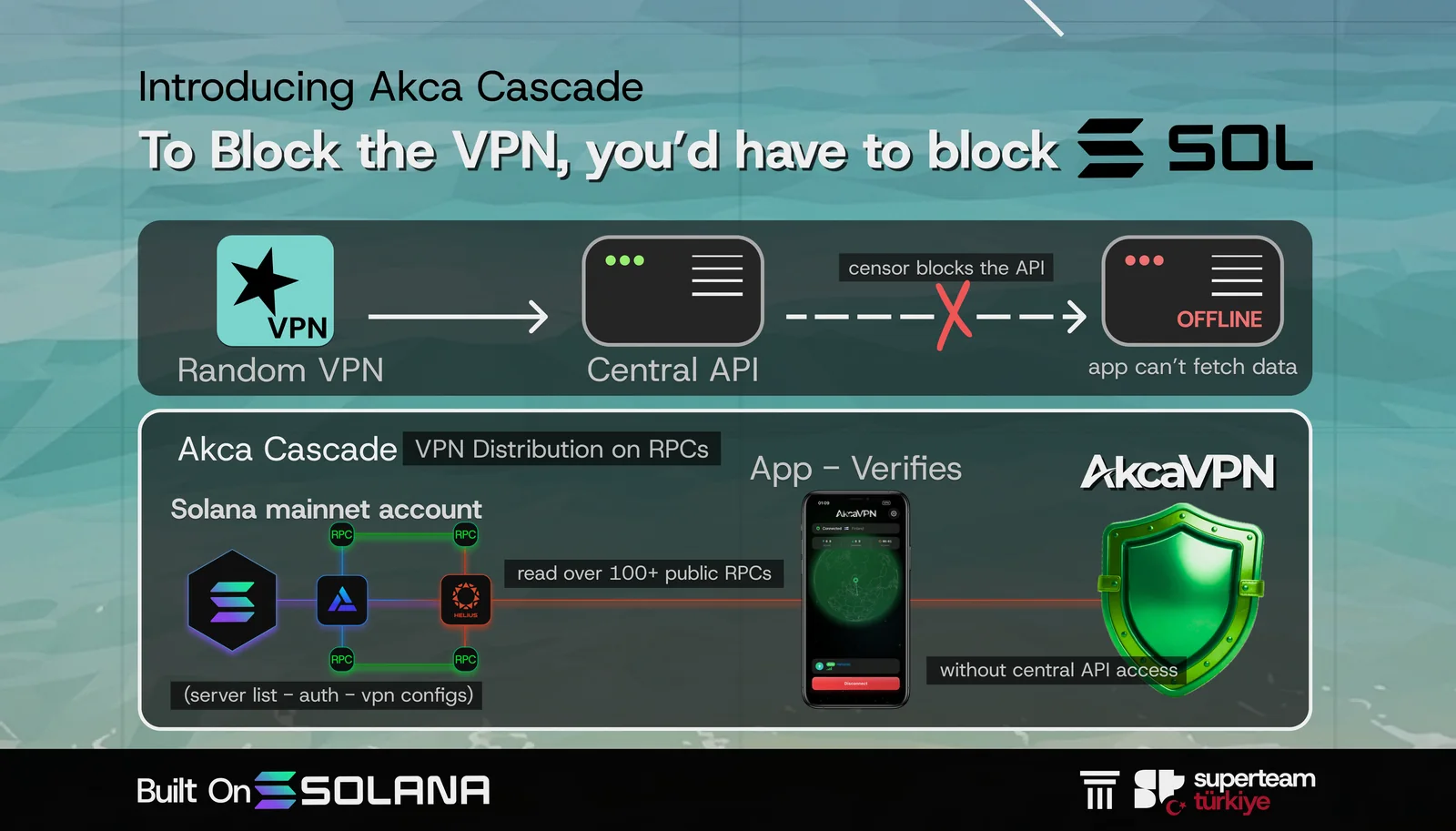
The traffic still rides the same WireGuard + AmneziaWG tunnel. Cascade only changes how the server list is distributed. The list is signed, so a client can prove it came from Akca and wasn't tampered with, before it connects.
Don't trust us. Read it yourself.
The Cascade config registry is a public Solana account. Pick any RPC endpoint below and read it straight from the chain: your browser talks to Solana directly, not to our servers. The server list itself is encrypted so a censor can't bulk-harvest it, but its existence, authenticity and freshness are public and verifiable.
Live on-chain read reading…
ConfigRegistry · program 9so5…vf59 · devnet
How it compares
| Property | AkcaVPN | Mullvad | Proton | Tor |
|---|---|---|---|---|
| No email / no account | Yes | Yes | No | Yes |
| No-logs (RAM-only) | Yes | Yes | Yes | Yes |
| DPI obfuscation | AmneziaWG | Partial | Partial | Pluggable |
| Survives an API block | Yes, on-chain | No | No | Bridges |
| Server list independently verifiable | Yes, on Solana | No | No | Consensus |
| Pay anonymously (crypto) | Yes, SOL/USDC | Yes | Limited | Free |
What's live now, and what's next
We don't overclaim. Here's exactly where Cascade stands.
- Server list published on Solana, signed by the Akca authority
- Readable from any of 100+ RPC endpoints, with automatic fallback
- Encrypted so the topology can't be bulk-harvested off the ledger
- Existing API stays as the automatic fallback path
- Works alongside WireGuard + AmneziaWG, unchanged
- Subscription validity published on-chain, verify access via RPC
- On-device key generation + direct node enrollment (API-less connect)
- Promotion from devnet to Solana mainnet
- Rolling out gradually across iOS, macOS and Windows
- Bridge to Wormtocol, quantum-safe, delay-tolerant transport
At launch, Cascade makes discovery censorship-resistant. The roadmap moves authentication and connection on-chain too, so the entire flow survives even a full API block.
AkcaVPN